Kids' Checked Luggage: A Child's Bag Is a Whole Allowance, Not a Small One
A child's suitcase is measured and charged exactly like an adult's, and on several carriers the allowance itself is only returned by a calculator. What the published kids' cases actually hold, and why dividing one checked bag usually beats adding a fourth.
Affiliate disclosure: some links in this article are tracked partner links; we may earn a commission at no cost to you, and it never changes what we recommend.
The verdict
- A child's bag is not a small allowance — it is a whole one, and on several carriers nobody will tell you in advance what it is. Air Canada routes the question to a tool: "If you’re travelling with an infant or child, you can view their checked bag allowance by using our baggage calculator," and warns that "Your final baggage allowance may differ as it is based on the date your ticket is issued." When the bag count is the thing generating the fee, the comparison worth running is a door-to-door luggage shipping quote against the carrier's per-bag charge.
- Kids' cases carry very little for what they weigh. Trunki publishes "Volume: 18 litres" against "Weight: 1.7kg / 3.8lb"; Mountain Buggy publishes "large storage capacity up to 35L" against a "Product weight" of "5kg / 11lbs". An adult checked case in the same weight class is published at 65 litres.
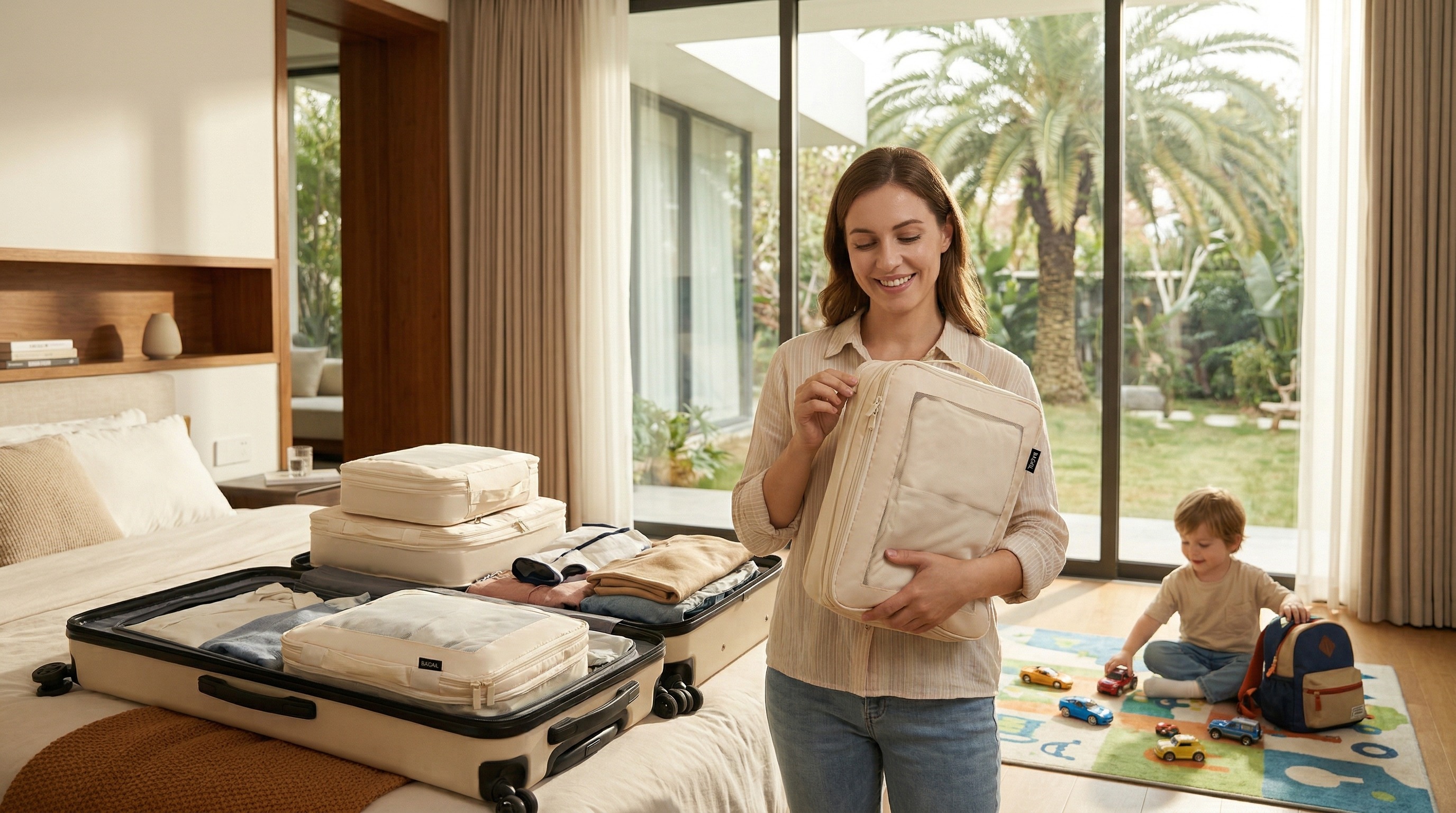
- The cheaper answer for most families is not a bag per child. It is one checked case divided into zones a child can work — Bagail publishes its cube sizes per piece, and six cubes in three sizes cost less than a fourth checked bag's fee on a single round trip.
The question that is actually being asked
No spam. Unsubscribe anytime.
"Best kids' luggage" is usually two different purchases wearing one label. One is a small case a child pulls through a terminal and keeps in the cabin — that is a carry-on problem, and the sizer-bin mechanics of it are covered in what gate agents actually measure and listed against overall dimensions. The other is whether a child gets a checked bag of their own, which is a question about allowance, fees and total weight. This page is about the second.
The distinction matters because the two have opposite economics. A cabin bag a child carries costs nothing extra on most fares. A checked bag a child owns consumes a paid slot, adds its own empty weight to the family's total, and is one more thing to collect at the carousel.
What a child's checked allowance actually is
Nothing generic. Read in September 2026, Air Canada does not publish a child's allowance as a figure at all; it returns one from a calculator that wants a route, a fare class and a loyalty tier, and it distinguishes an "Infant (0-2 years) NOT occupying a seat (on lap)" from an "Infant/child (0-11 years) occupying a seat (with own ticket)." A lap infant and a ticketed child are different cases and the page does not resolve either without a booking.
What is published is what any bag must satisfy, and it does not soften for children. Southwest states "62 inches in size (length + width + height)" with "Wheels and handles should be included when measuring" and bags "Up to 50 pounds each". Frontier states "Must not exceed 62 linear inches (length plus width plus depth, including handles, wheels, and straps)" and "May weigh up to 40 pounds," with overweight from "$75 per bag, per direction." Air Canada's per-piece ceiling is "23 kg/50 lb".
A child's suitcase is measured and charged exactly like an adult's. There is no smaller box and no reduced fee for a smaller bag. The full picture of how those bands work is in how the overweight fees actually work.
The capacity-to-weight problem nobody mentions
Here is the figure that should decide whether a child's bag gets checked at all.
Trunki's ride-on case publishes "Volume: 18 litres", "Size: 46 x 20.5 x 31 cm" and "Weight: 1.7kg / 3.8lb", with a "5-year guarantee" and a recommended age of "3-6 years". Mountain Buggy's bagrider publishes "large storage capacity up to 35L", dimensions of "52 x 38 x 26cm / 20 x 15 x 10"", and a "Product weight" of "5kg / 11lbs" for an age range of "9 months or when child can sit unaided - 3 years".
Set those against an adult checked case. LEVEL8's Luminous Textured 24-inch is published at "17.5'' L x 10.4'' W x 26" H | 9.8lbs | 65 L". The bagrider weighs eleven pounds and holds 35 litres; a checked case weighs a little under ten pounds and holds 65. On a ticket that charges per bag and caps weight per bag, a child's case is the least efficient object in the family's luggage — it spends allowance at roughly twice the rate per litre.
That is not an argument against buying one. It is an argument for keeping it in the cabin, where it costs nothing and does a second job, and putting the child's clothes in a checked case that is already going anyway. For the youngest travellers and what the makers actually publish about them, see ride-on suitcases and their published weight limits.
What a child's case is genuinely good at
Read the makers' own positioning and the case for a kids' bag gets narrower and more convincing at the same time. Mountain Buggy sells the bagrider as a way of "avoiding the struggle of taking both a buggy and carry on through transit" — the bag replaces a second object rather than adding one. Trunki backs its case with a term rather than a test: "we’re so confident of the quality that every Trunki suitcase is covered by our free 5-year guarantee."
Neither claim is about checked capacity, and neither should be. A children's case earns its money in the terminal, not in the hold — which is why the honest recommendation is to buy the smallest one the child can actually manage and never pay to check it.
Dividing one checked bag instead of adding a fourth
The practical substitute for a bag per child is a zone per child inside a bag that is already paid for.
Bagail's six-piece set is "three distinct sizes, with two pieces of each size included in the box" at "$30.99 USD": "2 x Large Cubes: 17.5" x 13.7" x 4"", "2 x Medium Cubes: 13.7" x 9.8" x 4"" and "2 x Slim Cubes: 13.7" x 5" x 4"". Two large, two medium and two slim gives three people a labelled block each in one 65-litre case, which is the configuration that actually survives a hotel room.
The seven-piece version at "$39.99 USD" is the one worth having with children, because of what it adds: "3 compression: 1L-1512.75, 2M-1410"; 3 packing organizers: 1XL-17.512.754", 1L-1512.753.5"; Slim-144.53.5";1 shoe bag-16.9x10.2". The shoe bag is the piece that keeps a child's footwear off everybody's clothes, and it is the cheapest problem to solve in this whole category. Which cube sizes fit a checked footprint is worked through in the best packing cubes for checked luggage, and whether to compress at all in compression against standard cubes.
If the family is buying several cases at once rather than cubes, the set question is argued in the best checked luggage set for a family.
When to stop adding bags and start shipping them
A family's fee exposure is multiplicative, and that is the specific condition under which shipping becomes worth pricing. Frontier charges "$75 per bag, per direction" at 41-50 pounds — levied on every bag that trips the band, in each direction.
Luggage Forward publishes pricing that "starts at $99/bag," delivery to "more than 200 destinations worldwide," and a commitment that a shipment is "guaranteed to arrive on time or we’ll refund you double what you paid to ship the bag." Neither side of that comparison is a fixed number — the airline's charge depends on fare and weight, the shipper's on route and speed — so the only honest instruction is to price your own itinerary on both. Check any case against the carrier's box first with our airline sizer tool.
What we could not verify
No airline we reached publishes a child's checked allowance as a static figure, so nothing here states one. Where this article gives a weight or a size, it is the per-bag ceiling that applies to everyone.
We found no maker publishing a durability test standard for children's luggage. Trunki publishes a five-year guarantee and Mountain Buggy publishes a load rating; neither publishes a drop, wheel or handle-cycle test, so the draft's claim that "recessed wheels outlast tiny exposed ones" is absent here — it is a plausible inference with no document behind it.
stokke.com did not render its JetKids BedBox specifications to our requests, so no Stokke figure appears. The draft's price band for a kids' ride-on is gone for the same reason: no page we read publishes a band.
Buying this as a gift and can't decide? Send a Giftcards.com gift card instead →
FAQ
Does a kid's suitcase count as a checked bag?
Yes, and it is measured and charged exactly like an adult's. Airlines publish a per-bag size ceiling of 62 linear inches and a per-bag weight cap, commonly 40 or 50 pounds, with no reduction for a smaller case. A child's bag consumes a full allowance slot on the booking.
How much luggage is a child allowed on a flight?
On several carriers you cannot look it up. Air Canada returns a child's allowance from a baggage calculator that needs the route, the fare and the loyalty tier, and distinguishes a lap infant from a ticketed child. Check the fare rules on your own booking rather than a general page.
Should each child have their own suitcase?
Only if the allowance supports it without a fee. A child's case holds far less per pound than an adult's, so adding one spends allowance inefficiently. Giving each child a labelled section of a checked case, and letting them carry a small cabin bag, usually costs less and weighs less.
What size suitcase should I buy for a child?
Buy for the cabin rather than the hold. Published kids' cases run around 18 to 35 litres, which is a fraction of a checked case, and their value is that the child manages the bag through the terminal. Put the clothes in a bag that is already being checked and keep the child's case with them.
Sources
- Trunki Ride-On Suitcase - Una the Unicorn — Trunki (accessed 2026-09-22)
- bagrider — Mountain Buggy (accessed 2026-09-22)
- Checked baggage — Air Canada (accessed 2026-09-22)
- I want to know about the checked baggage policy — Southwest Airlines (accessed 2026-09-22)
- Bag Options — Frontier Airlines (accessed 2026-09-22)
- 6 Set half mesh Packing Cubes - Various Sizes Travel Luggage Packing Organizers — BAGAIL (accessed 2026-09-22)
- 7 Set 70D Ultralight, 3 Compression Packing Cubes 3 Packing Organizers With 1 Shoe Bag — BAGAIL (accessed 2026-09-22)
- Luminous Textured Collection 18''/ 20''/ 24''/ 28'' — LEVEL8 (accessed 2026-09-22)
- Luggage Shipping Service - Door to Door Luggage Delivery — Luggage Forward (accessed 2026-09-22)
Affiliate Disclosure